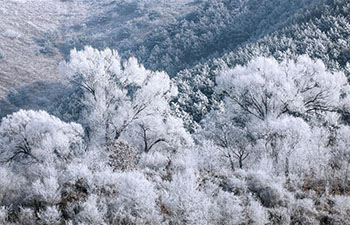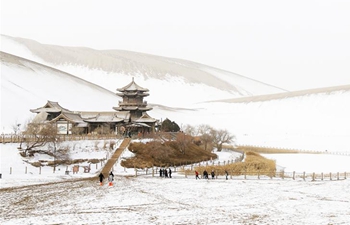
URUMQI, Jan. 24 (Xinhua) -- As the first rays of sunshine climb over the snowy mountains on the Akyaz Valley, Nurkaldi Tursunali drives his 60 sheep to the pasture before going back to his log cabin to drink milk tea by a burning stove. It is a typical start to the herdsman's day.
Winters are harsh in the valley. Nurkaldi's family and his flock do their best to dodge the bitter cold. About 130 kilometers from the nearest town, Akyaz is an important winter grazing place for herders in Zhaosu County, northwest China's Xinjiang Uygur Autonomous Region.
Despite an altitude of 2,000 meters, the Akyaz Valley has a warmer climate than surrounding areas and abundant grass and water. It is sometimes referred to as "the valley of life."
For centuries, herding has been an ancestral tradition for nomadic Kazakhs in Zhaosu. Migration begins in October, and more than 10,000 people drive 400,000 cattle and sheep to their winter homes, not leaving until May the next year.
To enter the valley, herders and their animals must pass a narrow, winding road. With cliffs on both sides, the road is just wide enough for a car to pass. Drivers hold their breath when zigzagging on the icy, rocky passage, careful not to fall off the cliff when taking sharp curves.
It usually takes two hours to drive to the heart of the valley. Sheltered by three mountains, the homes of the herders are scattered along the 200-kilometer long valley. The nearest neighbors are just 400 to 500 meters away, while some people live dozens of kilometers away and have to ride on horseback for two or three hours to visit a friend.
Amangul Hanuyalbik, 61, is the oldest herder in the neighborhood.
"I'm too old to work," he says. "Now I mostly work as the babysitter of my grandchildren."
He has passed on his whip to his son, who takes care of 250 sheep, 50 horses and 10 cattle.
In the daytime, men usually graze sheep and cattle on the pasture while women cook meat and naan bread at home. Their traditional dwelling is built with logs and mud. When night falls, the whole family gather around the stove, chatting over hot milk tea.
But life is not as poetic as it seems. The four doctors in the hospital in the valley know best how perilous life here can be. They have just saved a herdsman who fell from the cliff and nearly died from an intracranial hemorrhage. Years ago, an epidemic prevention member also brushed with death after falling from horse, when on the way to delivering oral poliovirus medicine to the local children.
Gyens, head of the hospital, has been working in Akyaz for 12 years. In the remote mountains, patients do not go to see doctors. Instead the doctors go house to house by car, motorcycle, horseback or on foot to treat minor illness and injuries, and send patients in serious condition to the county hospital. The doctors even treat animals.
Gyens has witnessed many changes over the years. Roads have been widened. Cell phone towers have been built. Solar panels have been installed so that herders no longer need to use kerosene lamps or candles for light. People have also set up satellite receivers to watch TV. Motorcycles are replacing horses.
"When spring comes, construction of the new hospital building will be complete," Gyens says.
Business has also taken root. The only shop nearby is owned by astute shop owner Baktikeld Bagaturbay, who has turned his little cabin into the local trading center. He sells beer, instant noodles and snacks, simple but sufficient to fill the stomachs of hungry herders.
"I started my business with a loan. Then my business expanded thanks to my wife's cooking. Now I can earn 4,000 to 5,000 yuan (about 625 to 781 U.S. dollars) every winter," he says.
Baktikeld is not only the most successful businessman but also the proudest father in the valley. As a top student, his daughter Aydala has been admitted to the "Xinjiang class" in Guangdong Province, south China, a program for students from Xinjiang to study in more economically developed regions.
About 5,000 kilometers from home, Aydala has inspired the children in the valley.
"When I grow up," 14-year-old Yeyeni tells his father Nurkaldi, "I want to work in the big cities."