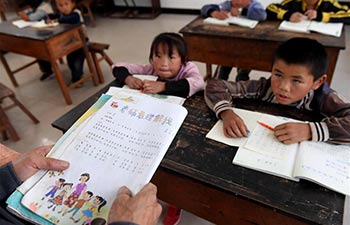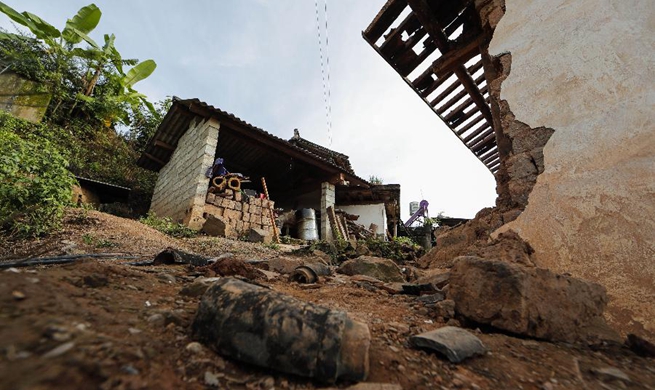
LHASA, Sept. 8 (Xinhua) -- Tibet's poverty levels are more than double that of China's average and the region seeks to garner more support from the country's centrally administered state-owned enterprises to alleviate this poverty.
Official statistics show that the amount of poverty in Tibet is unlike that found in other Chinese provinces. With all counties within its jurisdiction living in absolute poverty, Tibet is the only provincial region listed among the country's 14 toughest battlefields against poverty. Most of the other battles are being fought in mountainous counties.
Five years ago, Tibet had some 860,000 impoverished people and a poverty rate of 35.2 percent. With the impoverished population cut to 330,000, Tibet's poverty rate fell to 7.9 percent, still much higher than the national average of 3.1 percent.
With China's goal to eliminate poverty within its borders by 2020, the regional government of Tibet has relied on centrally-administered SOEs' contributions over the past decades, which have significantly boosted the local economy.
On Friday, a work conference was held in Lhasa attracting delegates from more than 40 central SOEs, where 15 new cooperation agreements were signed by a dozen SOEs, involving an aggregate capital input of 16.96 billion yuan.
When addressing the conference, Wu Yingjie, Communist Party of China (CPC) chief of Tibet Autonomous Region, said having central SOEs provide assistance to Tibet is "a state strategy of China revealing the advantages of the Chinese socialist system," as it will help narrow the regional development gap and make it possible for the country to be a well-off society in all aspects.
HEAVYWEIGHT PLAYERS
China has 98 SOEs centrally administered by the State-owned Assets Supervision and Administration Commission, whose aggregate profits exceeded 1.4 trillion yuan for the first time last year, up 15.2 percent from a year earlier.
In July, 120 Chinese enterprises were listed among the 2018 ranking of the Fortune Global 500, of which 48 are central SOEs, engaging in oil, petrochemical, coal, railway construction, building materials, manufacturing, modern services, and other industries.
In Tibet, central SOEs have capitalized on their respective advantages to cultivate new business, provide technical training, offer medical assistance, build schools and facilitate cultural and economic exchanges.
During the 13th Five-year period (2016-2020), central SOEs arranged aid packages worth 1.665 billion yuan to Tibet -- 474 million yuan more than their actual input made in the previous five-year period, an increase of 40 percent.
In the past two years, 16 SOEs have financed 175 poverty relief programs with more than 600 million yuan, benefiting 21,000 people in 240 villages, according to official local statistics.
China National Cereals, Oils and Foodstuffs Corporation (COFCO), the biggest food processor, manufacturer and trader in China, has cultivated a circular agricultural program in Lhozhag County where worm breeding and vegetable cultivation have been developed to produce natural feed for an egg farm, and therefore made the organically produced Tibetan eggs a new hit product.
The production value of this project surpassed two million yuan in 2017, benefiting 51 impoverished people, according to Li Guowei, a COFCO manager who has been working in Tibet for nine years dealing with poverty alleviation.
Through its controlled company China Mengniu Dairy, COFCO also provided technical assistance to a dairy factory in Chengguan District of Lhasa which went into operation on Friday. With a daily processing capacity of 150 tonnes of milk and an annual output of 50,000 to 100,000 tonnes of dairy products, the factory is expected to generate a production value of 550 million yuan and tax revenue of 50 million yuan annually. It has created 300 jobs and enriched 2,460 dairy cattle breeding households nearby.
"Tibet's poverty alleviation is particularly challenging because of its weak economic foundation, adverse natural environment, the lack of skilled workers and high costs. By sharing our experiences in the food industry, we hope to foster new businesses based on local resources for sustainable growth," said Li.
By participating in the poverty alleviation work, he said COFCO had shouldered its corporate social responsibilities, as the goal of an SOE is to benefit the public. "We seek no profits here, and we focus more on capacity building and technology transfer rather than charities," he said.
BETTER INFRASTRUCTURE
Since the central government instructed central SOEs to provide long-term assistance to support the development of Tibet in 2001, more than 300 managers like Li have traveled to Tibet to help alleviate poverty. So far, central SOEs have implemented more than 1,300 poverty relief projects and arranged a poverty relief fund of more than three billion yuan.
Central SOEs' contributions have also put huge efforts in improving local infrastructure facilities, making people's life much easier and optimizing the local business environment.
China Telecom, for instance, has invested more than 10 billion yuan since 2011 on the construction of communication networks. Currently, optical cables and 3G network are accessible in all townships, and 90 percent of Tibetan counties can use the 4G network now.
State Grid Corporation China (SGCC) has invested 36.3 billion yuan from 2013 to 2017 in upgrading the main power grids from 110 kilovolts to 220 kilovolts. It also financed the power grid upgrading in 2,797 villages with 12.7 billion yuan.
Sources with SGCC said the company's goal is to enhance the region's power supply capability and bring electricity to remote and impoverished counties.
Because of the improvement in these power and communication facilities, mobile internet access has been quite prevalent in the pasturing areas.
"In the past, we seldom saw herders sharing videos on Wechat. Now they are very much involved in the use of various mobile APPs. We often see interesting short videos shot by herders on various social media platforms. It's easy to know what it is like living in the pasturing areas," said Wu Haiyan, a local telecom employee.
To solicit the support of more central SOEs, the local government has worked out an investment catalog comprising 167 projects in seven key sectors.
On Thursday, a job fair tailor-made for local college graduates and Tibetans from poverty-stricken families opened in Lhasa, with more than 10,000 job vacancies from 140 central and local SOEs.