BEIJING, Nov. 8 (Xinhua) -- Under a bright sky in downtown Beijing, a white van with a special gas vessel sealed to its top smoothly and quietly runs up and down the street, catching the eyes of many.
Administrator of the United Nations Development Programme (UNDP) Achim Steiner was one of the passengers on the hydrogen-fueled vehicle. Instead of heading straight to his destination, he got off, took out his phone and circled the van for photos and videos.
"These fuel cell vehicles [FCVs] showcase the potential of a clean transportation sector," he said during his recent visit to China, impressed by his experience on the vehicle.
The van, produced by Chinese automotive manufacturer Foton Motor, is just the tip of the iceberg for the growing hydrogen-fueled vehicle sector that has been quietly sweeping across the country.
In Beijing, the No.384 bus with a hydrogen fuel cell has been carrying passengers for over ten years.
In the northern Chinese city of Zhangjiakou, a co-host city of the 2022 Winter Olympics along with Beijing, 74 hydrogen-fueled buses each run three routes across the city every day, accounting for 25 percent of the city's total number of buses, with 170 procured and yet to hit the road, according to Zheng Taipeng, an official with the city's bus company.
According to Zhang Weidong, a director of energy and environment at UNDP China, by the end of 2017, the total amount of FCVs in service in China had already surpassed 1,000, most of which were buses.
For him, the biggest advantage of a hydrogen fuel cell is that it generates electricity within the vehicles to power the motor using oxygen from the air and compressed hydrogen, and thus only emits water and a very small amount of carbon dioxide and oxynitride.
"We once tested the water it lets out, and it's even cleaner than a lot of drinking water on the market," said Zhang, who also manages a project on commercializing hydrogen fuel cell buses jointly launched by China's Ministry of Science and Technology (MOST) and Ministry of Finance in 2003, with support from UNDP and the Global Energy Facility.
Another advantage of a hydrogen fuel cell lies in its efficiency. At a hydrogen refilling station in Zhangjiakou, it took a fuel cell bus with eight hydrogen cylinders no more than ten minutes to finish its refueling, which could support the vehicle for another 400 kilometers or so.
"A fuel cell's service life is two to three times longer than that of an average battery," said Yang Shaojun, a senior engineer with SinoHytec, a state-owned high-tech enterprise that focuses on hydrogen fuel cells.
"Unlike lithium batteries, it's also environmentally friendly after being disposed of and highly recyclable, particularly the platinum on its surface," he said.
However, as the prospects of FCVs in the country keep booming and with the project deep into its third stage, which is expected to be completed by 2020, breaking through the bottlenecks in certain areas has become even more urgent.
"People still don't know enough about hydrogen these days," Wan Yang, assistant deputy country director of UNDP China, admitted.
"A lot of passengers aren't even aware that buses are driven by fuel cells," he continued. "We don't want them to jump to the conclusion that the buses they take contain hydrogen, or they will not do it anymore."
The common concern that hydrogen is highly hazardous has also affected the construction of more hydrogen stations, as they are generally considered inappropriate to be built anywhere close to houses, said Yang Shaojun, who expects more policies to be enacted to raise awareness of hydrogen as a safe and green energy.
"In fact, in open space, it is easier for hydrogen to diffuse than for gasoline, and the power of the explosion of hydrogen is less than that of gasoline of the same volume," Zhang Weidong explained.
Yu Dan, deputy director of the project, added that paperwork for building hydrogen stations for vehicles usually takes too long, because the procedures in different regions vary a lot.
"I have a lot of faith in the project's influence, after all," she said. "With rapid development in pilot cities, we can feel that the government's attention to the situation is always growing."
Her words have been backed by Wang Siqiang, an official with the National Energy Administration, who promised a better environment for the hydrogen industry to ensure its high-quality development at the 2018 China Hydrogen Energy and Fuel Cell Industry Forum last month.
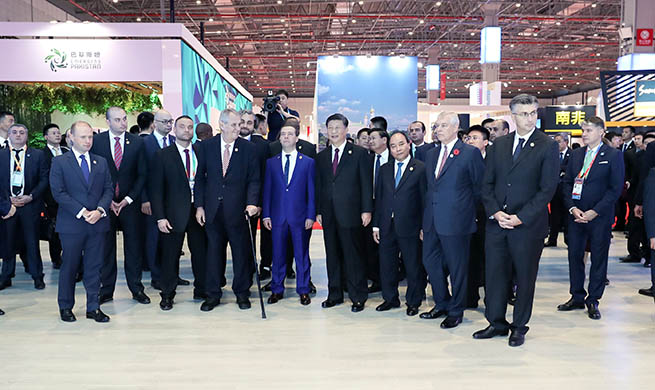
Moreover, at the ongoing China International Import Expo in Shanghai, FCVs are representing cutting-edge technologies in the automobile industry at the auto section, laying ground for further international cooperation in this area.
According to Zhang, since the launch of the project, over 30 listed companies in China have played their part in developing FCVs.
"I believe our country can also play a significant role on the international stage in terms of FCVs, especially in reducing their costs with the scale of its market and hydrogen production," he said.