by Xinhua writer Yu Fei
BEIJING, Jan. 12 (Xinhua) -- Chang'e-4's journey to the far side of the moon marks another remarkable achievement in China's space exploration, and will contribute to better understanding of the moon, the earth and the cosmos.
As nearest heavenly body, the moon has fascinated humankind since we first gazed at the sky. The silver disc in the sky is a key protagonist in our legends, myths and dreams. Its ever-changing face has inspired ambitious aspirations.
We admire its beauty from earth, so why are we so eager to reach the moon?
It's a link between us and the universe. It inspires our imaginations and dreams of space travel. The moon is still the only extraterrestrial destination visited by human beings.
The moon shares a violent early history with earth. Without the moon, life on earth might be very different. And we might see our past and future through exploration of the moon.
Because of the tidal locking effect, we only see one side of the moon from earth, and the far side remains a mystery. It's also called the dark side, although it's not darker than the near side. The word "dark" only shows how we feel about the unknown.
Mark Twain said everyone is a moon, and has a dark side which he never shows to anybody.
Nobody had ever seen the far side of the moon before the Soviet Union launched the Luna 3 probe in 1959. It was the first-ever mission to photograph the far side.
The United States Apollo 8 mission sent three astronauts around the moon in 1968, the first time humans saw the moon's far side with their own eyes.
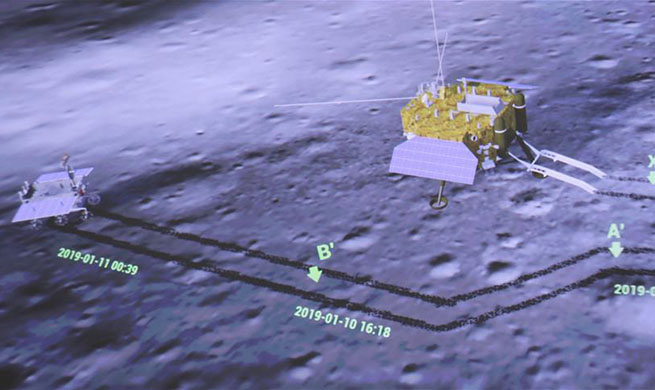
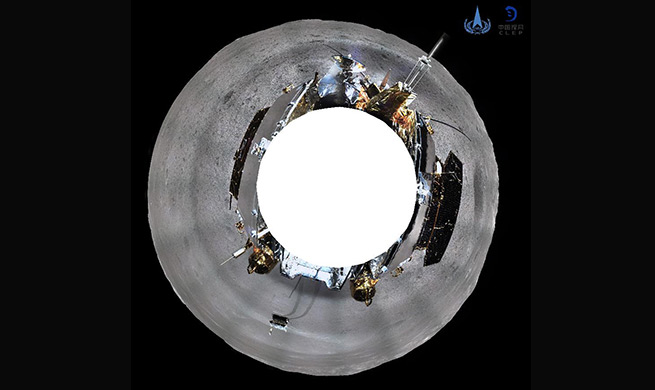
Now China has sent the first-ever probe to soft-land and rove on the far side.
To date, the world has launched about 130 manned or unmanned missions to the moon. Early exploration was dominated by the space race between the United States and Soviet Union in the 1960s and 1970s. After a lull, new interest was triggered in the 1990s when scientists found there might be water on the moon.
In 2007, exploration entered a new era, with countries such as China, Japan and India joining the lunar exploration club. Cutting-edge technologies in the fields of carrier rockets, navigation, communication and detection have been applied and will surely reap more discoveries.
Scientific research currently focuses on the origin and evolution of the moon, its current situation and lunar resources. Astronomers regard it as an ideal place to peer into the deep reaches of the cosmos.
Scientists also want to study the lunar environment, and whether people can live on the moon and the physical and psychological effects of living there. The study might help migration to other planets in future.
Flying to the moon has been a dream of Chinese since ancient times. The moon has long been a major theme in Chinese poems, music and paintings, with artists and writers using the moon to express their emotions and thoughts on the universe.
Since the 1990s, Chinese scientists and engineers have endeavored to make the dream a reality.
In 2004, China started its lunar exploration program, named after the moon goddess Chang'e, who, in Chinese mythology, lived on the moon and was accompanied by a jade rabbit. The program includes orbiting and landing on the moon, and bringing samples back to earth.
Unlike the space race of the 1960s and 1970s, China is developing its program in a scientific and rational way. Its investment is within the scope of China's capabilities.
Although China is a latecomer in lunar exploration, its program has made many achievements in a few expeditions and pushed forward the development of space technology, science and applications.
China has made several milestones in its space programs. The first was the launch of its first satellite in 1970, and the second was China's first astronaut Yang Liwei's journey in space in 2003.
Exploring the moon, about 400,000 km from earth, is the third milestone.
After the Chang'e-3 probe accomplished China's first soft-landing on the moon in 2013, Chinese space experts aimed high to make the Chang'e-4 mission more innovative and challenging: to realize the first-ever soft-landing on the far side of the moon.
In order to achieve that goal, China sent a relay satellite, named Queqiao, meaning Magpie Bridge, after an ancient legend, to the halo orbit around the second Lagrangian (L2) point of the earth-moon system to set up a communication link between the earth and the moon's far side. It is the first communication satellite operating in that orbit.
Chinese space experts also overcame difficulties with the rugged terrain on the far side, and soft-landed the probe on the Von Karman Crater in the South Pole-Aitken Basin with high precision.
China has become a major player in lunar exploration, which will benefit scientific research and improve understanding of the moon, the earth and the solar system.
The Chang'e-4 mission also carries instruments developed by scientists from Sweden, Germany, the Netherlands and Saudi Arabia, providing more opportunities for the world's scientists and combining human wisdom to explore the universe.
The idea of the halo orbit around the L2 point of the earth-moon system and deploying a satellite there as a communication link to the moon's far side was first proposed by U.S. scientists about half a century ago, but was realized by China.
Chinese space experts hope Queqiao will be able to assist other countries that intend to send probes to the far side of the moon within its life span.
Now China is drawing up plans to explore the polar regions of the moon, and inviting other countries to join in further expeditions.
From robotic to manned missions, from short to long-term, China's lunar exploration will go deeper. Chinese will leave their footprints on the surface of the moon in the foreseeable future.
Exploring the moon has inspired scientists and engineers; fascinated young and old; motivated young people to pursue scientific careers, not only in space, but also in the depths of the oceans, or in the nucleus of an atom.
Reaching the moon, the first outpost in deep space, is just the beginning of our space odyssey.