




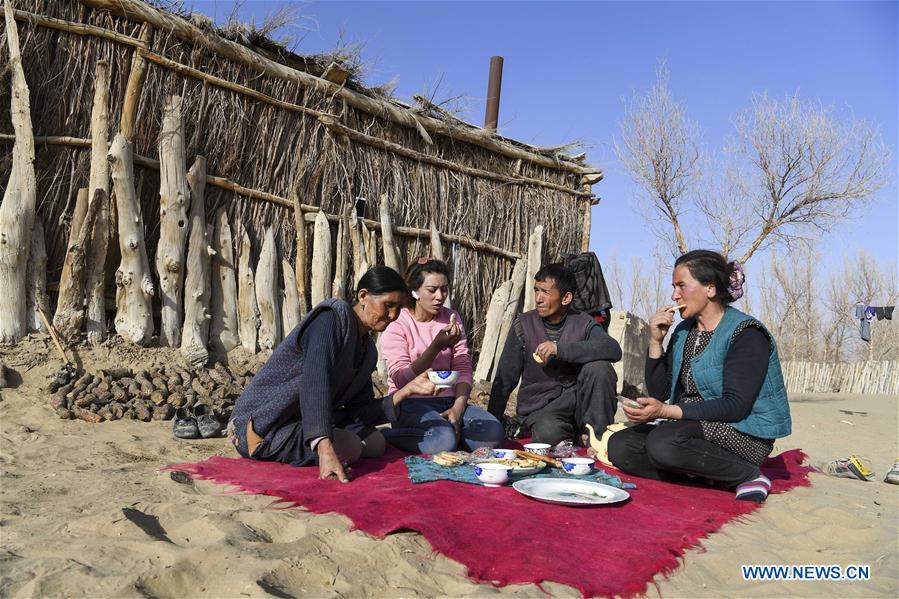
Imin (2nd R) and his wife (1st R) talk with local residents in Darya Boyi Town of Yutian County, northwest China's Xinjiang Uygur Autonomous Region, March 16, 2019. (Xinhua/Hu Huhu)
DARYA BOYI, Xinjiang, April 6 (Xinhua) -- Sheep herder Imin's home is at the heart of the Taklimakan Desert, the second-largest shifting sand desert in the world.
For hundreds of years, Imin's ancestors have settled along the Keriya River, which flows from south to north into the heart of endless sand dunes, branching out like fingers and providing the source of water for human habitats.
Imin, 39, knows every curve of the river, which part is muddy and must be avoided, and where to find enough weed to feed his sheep, but now he has to find a balance between maintaining his bond with nature, and carving out a future for his children.
Imin calls his home Darya Boyi, meaning "by the big river." It is also known as Tonguz Baste in books written by European explorers who visited the area in the 19th century.
Isolation from the outside world has kept life unchanged at the township. Now it has a registered population of 1,342 people. Some residents only started to use cell phones three years ago.
Even to this day, few people other than adventurers have made it this far into the desert. It is difficult to fathom how hard it is to get there. It takes a whole day to drive through gigantic sand dunes, muddy land and rugged river rocks to reach the town, 200 km from the edge of the desert.
Though the Keriya River has provided for the survival of Imin's ancestors, the environment has become less hospitable, with falling underground water level and frequent sand storms.
"The river was usually flooded when I was young, but now, from July to September, it completely dries up," said Imin.
A resettlement plan is underway to move the residents south to the edge of the desert, where better housing, drinking water facilities and roads are built.
The Yutian County government, which administers the town, started to draft plans for resettlement in 2016, said Tang Mingsheng, head of the county's poverty-relief office. In 2017, the first batch of 396 people, including 100 children, moved into the new settlement, about 110 km from the old town.
"The new town serves best for the 100 children, because they do not have to walk long distance between home and school any more," said Eziz Tohti, headmaster of the new school at the settlement.
This year, another 443 people, including Imin, his wife and father, will move to the new town.
"Before choosing the site of relocation, we asked if the folks would like to live in the county seat in apartments, but the folks prefer their new homes to be built closer to their old ones, where they can live the traditional way, herding sheep and harvesting desert plants," Tang said.
Tang and colleagues help young people find jobs and provide them with necessary training.
A kindergarten, an elementary school, a clinic, water facilities to treat high fluorine, a bus station, and a tourism center are under construction at the new settlement. A two-lane cement road was open a year ago to reach the new town.
Like his father Matkurpan, 81, Imin has barely received any education and has herded sheep by the river since the age of three, but his two sons are studying in six and seventh grade on a government grant.
The brothers only go home during summer and winter breaks because the journey home takes too long. "After my parents move into the new home, it is much closer to my school, and my brother and I will be able to go home at least once a week," said Bilal, the older brother.
Resettling means he has to change the routine of life that has been kept for generations, but the desire to be close to his sons led him say yes to the relocation plan.
Imin has an old cell phone, and he only gets weak reception up the trunk of a poplar tree in his yard and at one particular corner of his thatched fence.
"It took me quite a while to find the two spots. I only call my sons from there," he said.
When the people move out, the old town will still be open to people who want to herd there. The Yutian government plans to develop tourism in the area to help people improve livelihood.
Yutian has 165 villages, among which 114 are in deep poverty.
Tang Mingsheng and other local officials are looking for ways to eliminate the determinants of poverty by means of resettling, creating jobs, improving social welfare, providing training and others.
"Poverty reduction is a hard battle to fight, but no one shall be left behind," Tang said.
(Video reporters: Su Chuanyi,Hu Huhu; video editor: Zhang Yudong)
