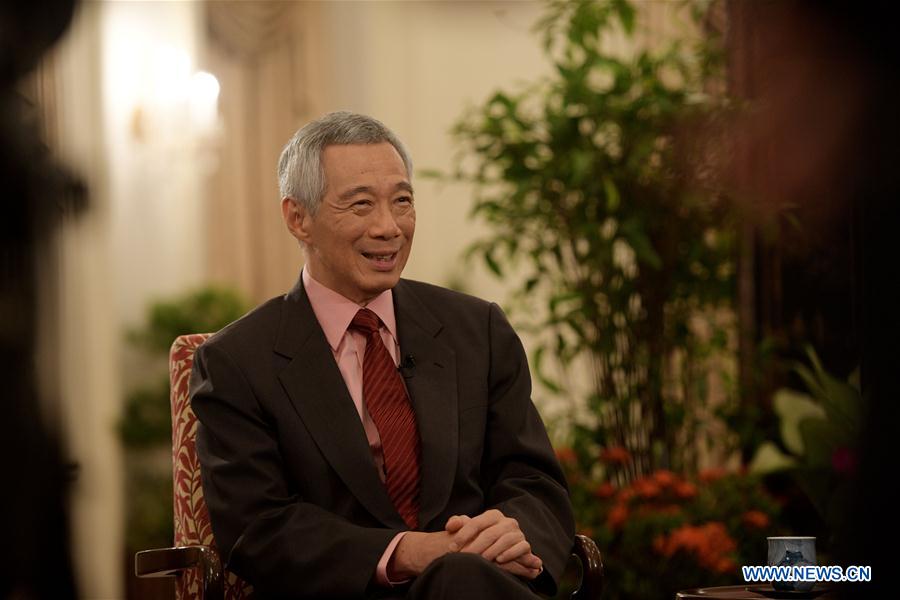
Singaporean Prime Minister Lee Hsien Loong receives an interview with Xinhua in Singapore, April 22, 2019. (Xinhua/Then Chih Wey)
by Li Xiaoyu, Xia Lixin and Wang Lili
SINGAPORE, April 23 (Xinhua) -- Singaporean Prime Minister Lee Hsien Loong said if the Chongqing Connectivity Initiative (CCI) between Singapore and China works, it will serve all the countries in the region and benefit China as well.
In an interview with Xinhua ahead of his visit to China for the second Belt and Road Forum for International Cooperation, Lee said one very important element of the CCI is the international land-sea transport connectivity, or the New International Land-Sea Trade Corridor, which is "a connection from Chongqing, south through Guizhou, through Guangxi to Qinzhou port, and from there, to Southeast Asia and the world."
He said that logistic businesses will save a lot of time traveling through the corridor because they do not have to go all the way down the Yangtze River and go through the Three Gorges, which are "very busy and all the way out to Shanghai and then double back in order to come to Singapore."
"If you come straight down by train, you put it onto a container on the ship, and then from the ship it comes to Singapore," the prime minister told Xinhua on Monday, adding that the corridor links Singapore with southwest China's Chongqing municipality. And more than that, it connects the Silk Road Economic Belt and the 21st-century Maritime Silk Road.
"I think therefore we see this as a very ambitious and important initiative. We are very glad that it has the full support of the Chinese government," he added.
Recalling the history of the CCI, Lee said that when being suggested by the Chinese government to do the third government-to-government project, Singapore thought about it "very carefully to find the right concept which would fit in with China's strategic needs, its priorities, and at the same time be a project where Singapore could make a useful contribution."
Eventually, Singapore determined to do the CCI and chose Chongqing, as the government wanted to make the connectivity in a broad sense, in terms of logistics, financial services, information technology, talent, and exchanges between Singapore and Chongqing, as well as the region surrounding Chongqing.
"What China has been focusing on has been developments of its western provinces, and also the Belt and Road Initiative. And we felt that in Chongqing, if we could have this connectivity initiative to connect the western part of China to Singapore and through Singapore to Southeast Asia and the world, this would fit in with your priorities and with our contributions."
The prime minister said China's agreement with Singapore on the CCI is very important because as there's a lot of potential in the western provinces of China, but the connectivity is an issue.
"If we have this initiative and we are able to cut down on the overheads, save time and make the connections more convenient in both directions, then I think that will make a big difference to Chongqing, to Sichuan, to the other provinces in western China," he said.
"It can make a very considerable difference also to Singapore, because we have good connections with the coastal cities and provinces, but for the inland cities, we are still in the developing stage," he added.
Lee highly appreciated the relationship between Singapore and China since they established diplomatic relations in 1990, saying the relations have transformed beyond recognition.
"The economic ties have grown tremendously, and the basis of this has been, of course, China's reform and opening-up, and our assessment and perspective that this has been a tremendous boon to China and the world," he said. "And in the process, we also hope to benefit from China's development and progress."
Looking forward, the prime minister said there is huge potential in the cooperation between Singapore and China. On the Belt and Road Initiative, the city state hopes to play a constructive part in financial services, third country investments, and human resources development.
Meanwhile, Singapore also works with China in regional cooperation. Lee said Singapore did its best to bring the relations forward and develop deeper ties between ASEAN and China as the coordinator country for ASEAN-China relations until last year, and Singapore is working with China on the Regional Comprehensive Economic Partnership (RCEP).
"We hope that all these will enable China to integrate constructively and peacefully into the regional economy and into the global trading and strategic system."
Lee opined that the key is China's overall strategy as it moves forward to develop relations with the other major powers in a constructive, stable, and mutually beneficial way.
When talking about protectionism, the prime minister said Singapore is very concerned because it is a very open economy, highly dependent on the global system and external trade.
"But actually, it is not only bad news for us, it is bad news for the whole world," Lee said.
He believed that it is not easy to maintain the global system because the changes needed in the countries are far reaching. The impacts are not always easy to accommodate. For some portions of the population who are not so well prepared to cope with the changes, it can be very disruptive.
"And so, we have a problem because the international system needs to adapt and be adjusted in order to be able to work with this new situation with a very big player coming onto the scene, China, and having a very big influence and impact on the world," he said.
Besides, Lee shared his views on Singapore's future economic growth with Xinhua, saying if the city state can maintain 2 to 3 percent growth, "that will be a good sustained rate of growth."
He said that Singapore's economy will "depend on productivity, improvements using new technology, organising ourselves more efficiently, shifting to new industries, new businesses, new sectors, where there is growth, where we have an advantage, where we can make a contribution and be relevant internationally."
Secondly, Singapore has to upgrade its people, so that they are individually productive with their skills and their knowledge in order to do the new jobs which are available.
Thirdly, Lee said that maybe the most difficult problem is to make sure that Singapore's population is maintained and the city state has enough babies so that in the next generation, there are enough Singaporeans to maintain the economy.
These are priorities for Singapore to keep its economy vibrant and growing. Internationally, the country tries to play a constructive role in ASEAN, in the Asia-Pacific Economic Cooperation, in regional cooperation with China and other countries, such as the United States and European countries.