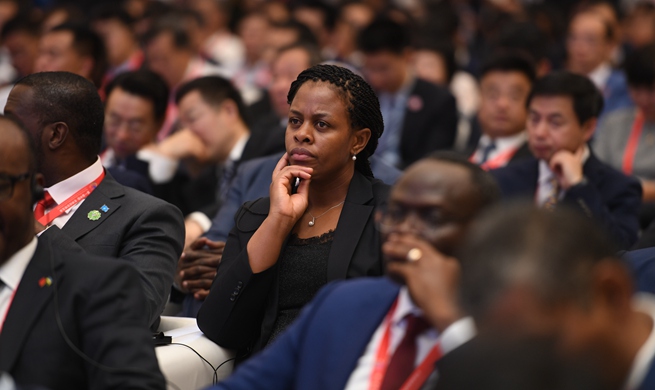
by Xinhua writer Zuo Chang
MANAMA, June 27 (Xinhua) -- The U.S.-led two-day workshop aiming to promote a money-for-land plan to solve the Palestinian issue concluded here on Wednesday, without the endorsement of the Palestinian National Authority.
The peace plan, also known as the Deal of the Century, was mainly drawn up by Jared Kushner, senior advisor to U.S. President Donald Trump, amid an escalation of the decades-long conflict triggered by a U.S. declaration of Jerusalem as the capital of Israel.
While Washington has claimed that the deal would launch a 10-year investment fund of about 50 billion U.S. dollars to help the Palestinians create over a million jobs and reduce their poverty rate by half, the Palestinians apparently didn't place much confidence in it.
"If a plan asks the Palestinians to drop their national agenda by just giving them a lot of money, it is nothing but a humiliation as if they could be bribed by money," Nimrod Goren, head of the Israeli Institute for Regional Foreign Policies, told Xinhua.
CONFLICT SINCE 1948
The current conflict between the Palestinians and the Israelis dates back to as early as mid-1948, about half a year after the United Nations (UN) General Assembly adopted Resolution 181, which recommended the creation of a Palestinian state and a Jewish state in the then British Mandate territory of Palestine.
After Israel declared independence in 1948, it continued waging war with neighboring Arab states in a bid to expand its territory, triggering a massive forced exodus of Palestinians from their homes.
The long-running conflicts culminated in the Six-Day War in 1967, during which Israel seized the Gaza Strip, East Jerusalem and the entire West Bank.
After the war, the UN Security Council unanimously passed Resolution 242 as part of the UN Charter to urge Israeli forces to withdraw from all territories occupied in the 1967 Middle East war, which obviously was not fulfilled by the country.
Since then, the situation in the region has kept alternating between skirmishes and brief lulls with the mediation of the international community.
However, Israel's continuing expansion of settlements on the occupied Palestinian territories has increasingly become another wedge driven between the two sides, and eventually led to the collapse of the last round of peace talks in 2014.
In 2016, the UN Security Council adopted Resolution 2334 which described Israel's settlement activity as a "flagrant violation" of international law and asked it to stop such activity immediately.
Backed by the UN resolutions, the Palestinians now seek to establish an independent, fully sovereign state along the 1967 pre-war borders with East Jerusalem as its capital.
MOTIVE BEHIND PROVOCATIONS
Since U.S. President Donald Trump assumed office in 2017, Washington has started to veer from decades of commitment to the two-state solution for the Palestinian-Israeli conflict toward being equivocal about the future of the Palestinians.
In May 2018, the United States relocated its embassy in Israel from Tel Aviv to Jerusalem, further alienating the Palestinians who, along with all other Muslims, revere Jerusalem as the third holiest site in Islam after Mecca and Medina.
After taking the core issue of Jerusalem off the negotiating table by relocating its embassy against the Palestinians' will, Washington announced on Aug. 31, 2018 that it will end all funding to the UN Relief and Works Agency for Palestine Refugees in the Near East (UNRWA), a move that has plunged the UN relief agency into a widening budget gap.
Over a week later, the U.S. State Department announced the closure of the Palestine Liberation Organization's office in Washington, citing its lack of steps to advance direct negotiations with Israel, days before revoking the visas of the Palestinian ambassador to the United States and his family.
In an interview published by the New York Times earlier this month, U.S. Ambassador to Israel David Friedman said that Israel has the right to annex parts of the West Bank while blaming the Palestinian Authority for the stalemate in the peace process.
"It is obvious that the recent U.S. measures taken against the Palestinians aimed at blackmailing us into surrendering and accepting the peace deal," Palestinian Prime Minister Mohammed Ishtaye said in May.
SELLING ILLUSIONS
No sooner had the White House and the Bahraini government announced on May 19 the launch of the economic workshop, which is widely acknowledged as the first step of the Deal of the Century, did the Palestinian Authority voice strong opposition to both the workshop and the U.S. peace plan.
"Any peaceful solution should depend basically on ending the occupation and gaining the national rights of the Palestinians," said Ishtaye.
"The economic factor is an outcome of the political settlement because the Palestinians and their leadership do not seek enhancing living conditions under occupation," the Palestinian prime minister noted.
According to Secretary General of the Palestine Liberation Organization Saeb Erekat, the Palestinians had never been consulted on the U.S.-led economic workshop before its announcement.
Meanwhile, Hamas, a Palestinian Islamist organization that rules the Gaza Strip, also called on the Palestinians to boycott the U.S.-sponsored workshop in Bahrain.
"Our people are unified to boycott the workshop in Manama and act against the Deal of the Century and the projects of liquidizing the Palestinian cause," Khalil al-Hayya, deputy chief of Hamas, told reporters on May 24.
On May 27, Palestinian President Mahmoud Abbas went further by slamming the Deal of the Century as "selling illusions."
"They are selling us illusions that won't take us anywhere, and we are not in need of their aid because our people are able to build their state," Abbas told a ceremony held at his office in Ramallah.
The Palestinian Authority severed all political contacts with the Trump administration after he recognized Jerusalem as Israel's capital in 2017.
Since then, the Palestinians have been appealing for an international multilateral mechanism to help solve their conflict with the Israelis, not trusting the United States in the role as an honest mediator for peace.
Last month, three Gulf and Arab summits were held in Saudi Arabia, where the Arab countries reaffirmed their consistent support for the establishment of an independent Palestinian state with East Jerusalem as its capital.
On June 2, Egyptian President Abdel Fattah al-Sisi said his country would not accept anything undesired by the Palestinians, hinting at the U.S. Deal of the Century.
"The political solution to the Palestinian issue is the right way at present. The workshop in Bahrain which only focuses on economic means can not convince the Palestinians or win the recognition of Arab states and the international community. Ultimately, it serves the American interests," Ahmed Abu Wafa, a Cairo-based political analyst, told Xinhua.
(Xinhua correspondents Liu Weijian, Lyu Yingxu and Chen Wenxian contributed to the story.)