



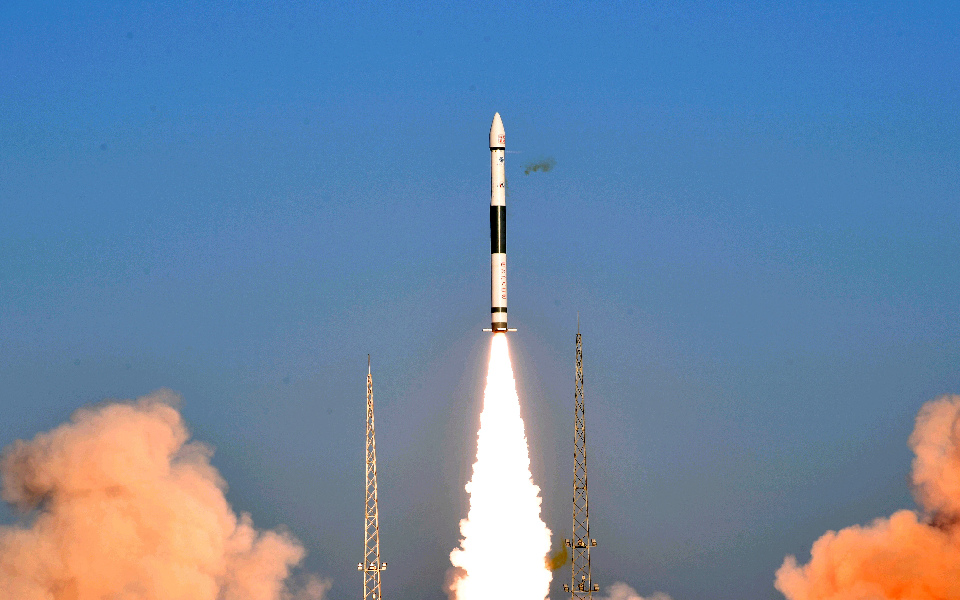
Two satellites for technological experiments are sent into space by a Kuaizhou-1A, or KZ-1A, carrier rocket from Jiuquan Satellite Launch Center in northwest China's Gansu Province, on Aug. 31, 2019. (Photo by Wang Jiangbo/Xinhua)
The rocket is mainly used to launch low-orbit microsatellites.
JIUQUAN, Aug. 31 (Xinhua) -- Two satellites for technological experiments were sent into space by a Kuaizhou-1A, or KZ-1A, carrier rocket from the Jiuquan Satellite Launch Center in northwest China on Saturday.
The rocket blasted off at 7:41 a.m. and sent the two satellites into their planned orbit.
Kuaizhou-1A, meaning speedy vessel, is a low-cost solid-fuel carrier rocket with high reliability and a short preparation period. The rocket, developed by a company under the China Aerospace Science and Industry Corporation, is mainly used to launch low-orbit microsatellites.
Saturday's launch was the third mission of the KZ-1A rocket.
One of the newly launched satellites was developed by the Innovation Academy for Microsatellites of the Chinese Academy of Sciences (CAS), and will be used for microgravity technology experiments.
It will conduct on-orbit experiments on ultra-high precision control and measurement technologies under microgravity conditions, according to the CAS.

Two satellites for technological experiments are sent into space by a Kuaizhou-1A, or KZ-1A, carrier rocket from Jiuquan Satellite Launch Center in northwest China's Gansu Province, on Aug. 31, 2019. (Xinhua/Jin Liwang)
The technologies will lay a solid foundation for space science tasks and frontier basic science research, such as space-based gravitational wave detection and ultra-high precision inertial navigation, CAS said.
The other satellite, developed by Spacety Co., Ltd. (Changsha), a privately owned Chinese commercial space company, will be used to test solar sail technology.
The microgravity technology experiment satellite belongs to the second phase of a space science program of the CAS. During the first phase, a series of space science satellites have been sent into space, including the DAMPE to search for dark matter, the world's first quantum satellite and the HXMT, China's first X-ray space telescope.
In the coming three to four years, China plans to launch new space science satellites including the Gravitational Wave Electromagnetic Counterpart All-sky Monitor (GECAM), the Advanced Space-borne Solar Observatory (ASO-S), the Einstein-Probe (EP) and the Solar wind Magnetosphere Ionosphere Link Explorer (SMILE) to study gravitational waves, black holes, the relationship between the solar system and humanity, and the origin and evolution of the universe.
