



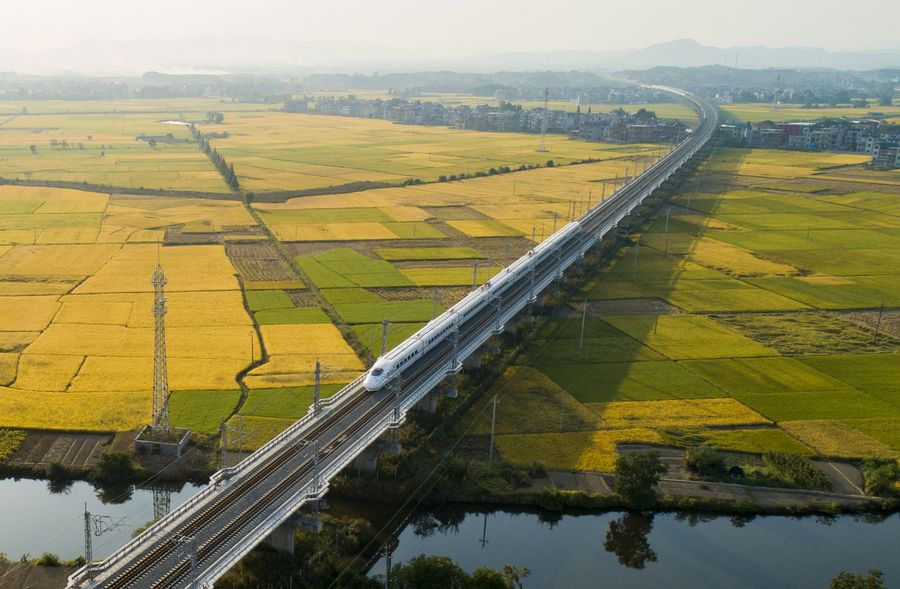
A bullet train runs past the fields in Duchang County, east China's Jiangxi Province, Oct. 6, 2018. (Xinhua/Fu Jianbin)
In the eyes of China pessimists, doom and gloom seemed the only possible scenario for China amid trade disputes and mounting external uncertainties. To their surprise, or dismay, resilience and vigor of the Chinese economy have proved quite the opposite.
By Xinhua writers Zhang Yiyi, Liu Yinglun and Wang Xiuqiong
BEIJING, Dec. 24 (Xinhua) -- As the year 2019 draws to an end, China pessimists may find little evidence, again, to flesh out their ill-informed and misleading claims on the economy.
In their eyes, doom and gloom seemed the only possible scenario for China amid trade disputes and mounting external uncertainties. To their surprise, or dismay, resilience and vigor of the Chinese economy have proved quite the opposite.
Here is a fact-check on how at least six false claims about China's economy have fallen apart this year.
NATURAL SLOWDOWN OR BLEAK GROWTH?
Some scare-mongers have long tried to sell the message of a "hard landing" of the Chinese economy, whose resilient growth this year made this theory all the more flimsy.
China's GDP expanded 6.2 percent year on year in the first three quarters of 2019, data from the National Bureau of Statistics (NBS) showed. The growth, in line with the government's annual target of 6-6.5 percent set for 2019, still outpaces other major economies including the United States, Japan, Germany, India.
The slowdown, rather than a steep fall, is "to be expected and not surprising or alarming in any sense," as the economy is moving along an expected natural path of maturing growth following its unprecedented growth pace over four decades, said Ahmed Saeed, Vice President of the Asian Development Bank.
Global ratings agency Fitch in November maintained its A+ credit rating on China, affirming its stable growth outlook supported by the country's robust external finances and strong macroeconomic performance.

Assembly workers install the battery pack for a new energy vehicle at Xi'an plant of BYD Auto in Xi'an, northwest China's Shaanxi Province, June 12, 2019.(Xinhua/Shao Rui)
STABLE JOB MARKET OR EMPLOYMENT CRISIS?
Navigating through headwinds, China has delivered robust job gains with a stable unemployment rate instead of massive lay-offs like some naysayers suggested. NBS data showed that 12.79 million new urban jobs were created in the first 11 months this year, exceeding the annual goal of creating more than 11 million new jobs.
As China's economic structure has shifted from an industry-led one to a service-led one, the growing service sector, new business models and multiple support policies are also generating more opportunities.
Every percentage point growth of the country's economy can be translated into around 2 million new jobs, said Liu Aihua, spokesperson of the NBS, adding that the job market is kept stable as steady economic growth, structural adjustments and entrepreneurial innovation continue apace.
MADE-IN-CHINA: BOOM OR GLOOM?
In another sign of economic resilience, made-in-China continued to display dynamism in spite of increased downward pressure. NBS data showed that the purchasing managers' index for China's manufacturing sector re-entered the expansion zone by firming up to 50.2 in November from 49.3 in October.
Analysts suggested that China, as the only country that possesses all the industrial categories in the United Nations industrial classification, has the competitive edge of a complete and efficient supply chain.
As the country continued its structural shift to quality-oriented growth, high-tech manufacturing has also been forging ahead, with an output increase of 8.9 percent in November, and investment surging 14.8 percent year on year in the first 11 months of the year, far outpacing the manufacturing sector's average growth of 2.5 percent, official data showed.
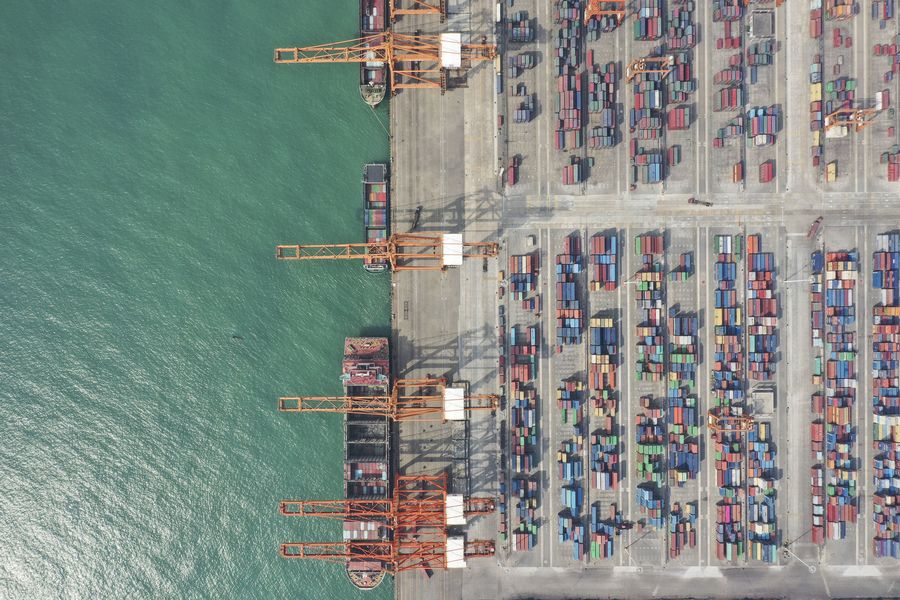
Aerial photo taken on Nov. 23, 2019 shows a container terminal at Qinzhou Port in south China's Guangxi Zhuang Autonomous Region.(Xinhua/Cao Yiming)
FOREIGN TRADE: FIRMING UP OR FALTERING?
At odds with what some market observers may have surmised, China's foreign trade has remained steady this year, climbing 2.4 percent year on year to 28.5 trillion yuan in the first 11 months with the exports of high-tech, high-quality and high value-added goods expanding at a faster-than-average rate.
The scope and scale of foreign trade kept growing as China opens wider to the world. In the first 11 months, China's trade with the EU and ASEAN expanded, while trade with countries along the Belt and Road reported faster growth than the overall average to account for 29.3 percent of the total trade.
China's commitment to increasing imports is evident in hosting the China International Import Expo and adjusting import tariffs for a range of products starting next year, both allowing other countries and regions to share in China's development.
FOREIGN FIRMS: INVESTING OR RETREATING?
Misgivings of foreign firms withdrawing from China under trade tensions and rising costs are overblown, as the country saw foreign direct investment (FDI) utilized in the first 11 months rising 6 percent year on year, and more than 100 new foreign-invested firms set up every day.
China remains the second-largest recipient of FDI and the largest among developing economies, according to a report by the United Nations Conference on Trade and Development.
The country has taken concrete policies and legislative measures to improve its business environment that grants equality of rights, opportunities and rules for domestic and foreign companies alike, ascending 15 places to rank 31st globally this year on the World Bank's ease of doing business list.

Photo taken on Oct. 25, 2018 shows a night view of the Lujiazui area in Shanghai, east China. (Xinhua/Liu Ying)
CAPITAL MARKET: IMPROVING OR IMPLODING?
Defusing risks and improving the market system, China saw its capital market make a bullish run so far this year, with the Shenzhen Component Index hiking almost 40 percent and the Shanghai Composite Index up nearly 20 percent from closing on the last trading day of 2018.
China's financial opening-up efforts, which include stock connect schemes and scrapping QFII & RQFII quota into the country's capital market, as well as its strong and increasingly international currency, made yuan-denominated assets more attractive to investors worldwide as foreign holdings of Chinese stocks and bonds jumped 53.56 percent and 27.6 percent respectively in the first nine months of this year.
Inclusion to and increased weighting of China's stocks and bonds in global benchmarks like the MSCI, FTSE Russell, S&P Dow Jones and Bloomberg Barclays index are expected to channel more foreign capital into China's financial market, while ongoing reforms including the registration-based IPO system and spin-off listings bode sustainable growth.
En route to high-quality and more sustainable growth, China is yet to dazzle the world as it stands poised to finish building a moderately prosperous society in all respects next year and turn its institutional strength into better governance in the long run. ■
